

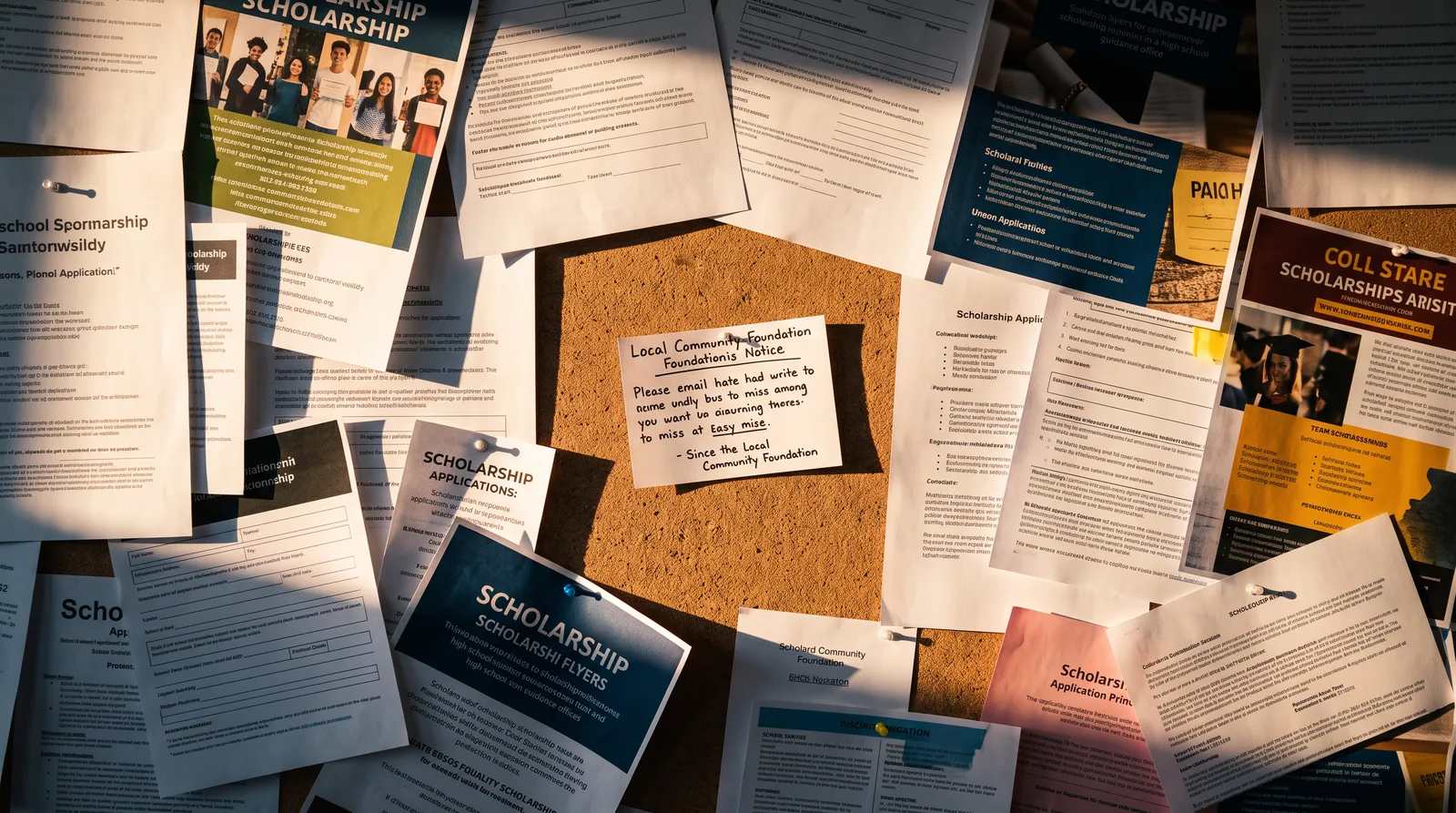
Generic essays, missed deadlines, and overlooked local awards are silently draining thousands of dollars from your financial aid package. The good news: every one of these mistakes is fixable, and most are fixable before you submit a single application.
1. Writing one generic essay for everything
A single all-purpose essay reads as exactly that — generic. Reviewers can tell when an essay wasn't written for their award. The fix: write one strong personal statement, then adapt the opening, the framing, and the conclusion to each scholarship's specific mission. Reuse the core story; tailor the angle.
2. Missing deadlines
More scholarship money is lost to missed deadlines than to weak essays. The fix is a system: one tracker with every deadline, every requirement, and every essay prompt, reviewed weekly. Block time for applications the way you'd block time for a class. A late application is a rejected application.
3. Ignoring local and institutional scholarships
National scholarships are glamorous and nearly impossible to win — applicant pools in the tens of thousands. Local Rotary clubs, credit unions, community foundations, and your target colleges' own institutional scholarships have pools in the dozens or hundreds. The fix: spend one afternoon listing every local source you can find. The odds are dramatically better, and the dollars stack.
4. Skipping scholarships that "require work"
Essays, interviews, and video components scare away most applicants — which is exactly why those scholarships are easier to win. The fix: treat every "extra requirement" as a filter that eliminates your competition, not a reason to skip. The students who win the most money are the ones willing to do the work others won't.
5. Not reusing essays ethically
Writing every essay from scratch burns you out and guarantees missed deadlines. The fix: build a small library of reusable components — a personal statement, a leadership story, an academic-interest essay, a community-impact essay — and adapt them to each prompt. You're not recycling; you're repurposing strong material so you can apply to more awards with higher quality.
None of these mistakes reflect your ability; they reflect your system. Fix the system and the money follows.
Show Me The Money
Turn these notes into a structured, step-by-step practice — with progress tracking, assessments, and personalized guidance.
Explore the course
